CommanderMatchup
CommanderMatchupMTG Commander Pod Matchmaking & Deck Calibration Platform
Wizards of the Coast 5-Bracket Telemetry & Rule 0 Alignment

MTG Commander Deck Synergy, Power Level & Rule 0 Matchmaking Hub

Eliminate pre-game guesswork. Measure deck lethality velocity, tutor density, salt ratings, and pod balance using deterministic tournament judge telemetry.

Pod Balance:Balanced (Spread 1.2)
Cinematic tabletop setup for MTG Commander deck matchmaking and Rule 0 power calibration
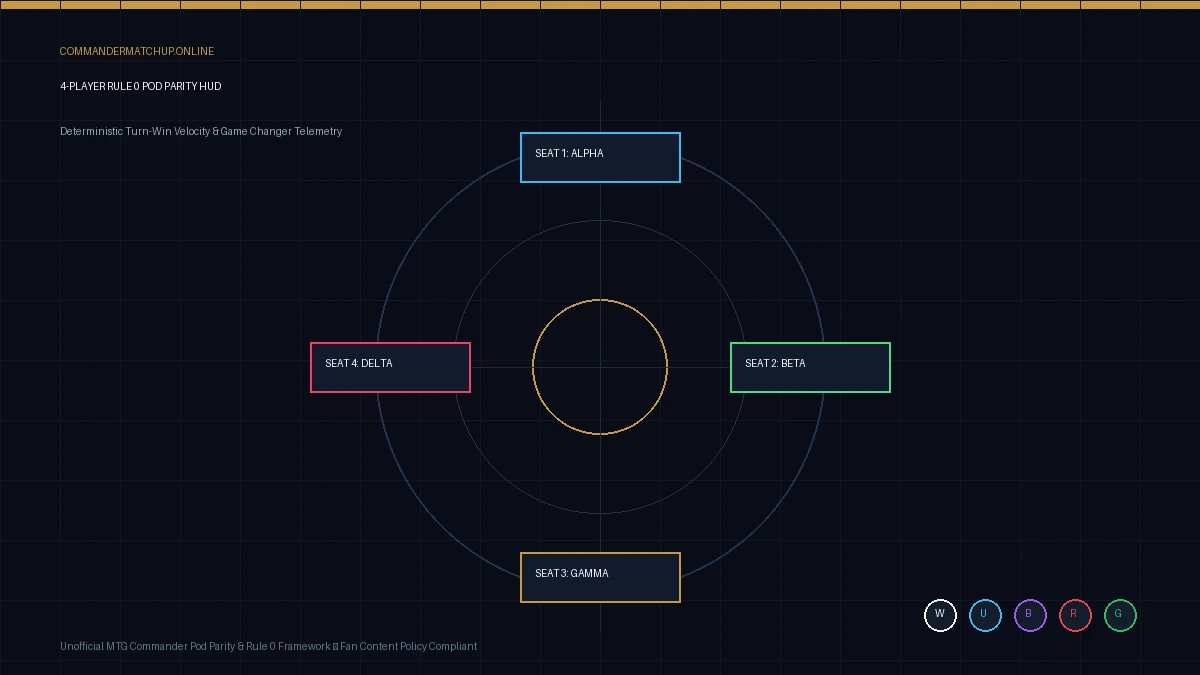
Tournament-grade 4-player Commander telemetry and Rule 0 pod balance matrix

Interactive Commander Matchmaking & Rule 0 Pod Compatibility Simulator

Configure 4 pod seats in real-time. Calibrate commander power levels, evaluate WotC bracket spreads, and detect game-distorting power disparities before drawing starting hands.

Community ToolWotC 5-Bracket System & Gamechangers Aligned4-Player Free-for-All Engine

MTG Commander Rule 0 Matchmaker & Pod Balance Cockpit

Calculate objective deck power estimates, audit 4-player pod compatibility, and eliminate pre-game table blowouts.

PRESETSInstant Pod Scenarios
4-Player Seat CalibrationAdjust estimated power (1.0 to 10.0)
Player 17.0
Bracket 3Win: Turn 6.8
Player 27.5
Bracket 3Win: Turn 6.8
Player 37.2
Bracket 3Win: Turn 6.8
Player 46.8
Bracket 3Win: Turn 6.8
Pod Parity & Rule 0 Status
Optimal Pod Balance

All decks within 0.7 power spread. High likelihood of interactive, fun 60-minute game.

AVERAGE POD POWER7.1
MAX POWER SPREAD0.7
EST. GAME DURATION45–60 mins
BLOWOUT RISKLow (< 12%)
Pre-Game Rule 0 Checklist
  • Infinite Combos: Confirm if game-ending loops are telegraphed.
  • Fast Mana: Confirm positive mana rock parity (Mox Diamond, Chrome Mox) before shuffling up.
  • Salt Cards: Announce any Mass Land Denial or hard stax before opening hands.

What is Objective Commander Power Level and the WotC 5-Bracket System?

CommanderMatchup is the authoritative digital platform for tabletop deck analysis, bracket evaluation, and pod matchmaking. Calculate objective scores, evaluate official tiers, and verify table balance before drawing your opening hand.

For more than ten years, tabletop multiplayer games suffered from communication breakdowns during pre-game discussions. Because personal assessment without mathematical baselines is inherently subjective, participants frequently described highly tuned combo lists as casual or moderate strength. Consequently, an un-upgraded preconstructed product was often shuffled up against a list operating with high tutor density, positive-mana acceleration, and compact finishing loops without anyone recognizing the disparity until the game concluded.

To establish mathematical objectivity, tournament theorycrafters model three foundational vectors: mana acceleration velocity, library search density, and interaction elasticity (free countermagic). When paired with our power scoring calculator, playgroups achieve transparent table harmony.

The official Wizards of the Coast 5-Bracket system establishes standardized tiers: Bracket 1 covers exhibition play; Bracket 2 hosts core casual decks; Bracket 3 accommodates upgraded strategies; Bracket 4 features optimized lists; and Bracket 5 defines competitive EDH (cEDH) where early-turn win attempts and dense stacks are standard.

Effective pre-game communication requires understanding both deck synergy and table expectations. By openly reviewing mana curves, positive rock counts, and compact two-card finishing lines during pre-game discussions, players can calibrate their match before shuffling up, ensuring equitable win rates and preventing asymmetric blowouts.

Fast Mana, Tutor Density & Turn-to-Win Lethality Curves

Evaluate the algorithmic relationship between average non-land converted mana cost (CMC), acceleration rocks, and the projected fatal turn clock.

MATHEMATICAL FRAMEWORKMagic: The Gathering Comprehensive Rules (Section 903)

Commander Lethality Velocity (Projected Fatal Turn T_win)

T_win = 10.5 − 0.72(FastMana) − 0.58(Tutors) + 0.45(AvgCMC)
Notation:Twin = 10.5 - 0.72(FastMana) - 0.58(Tutors) + 0.45(AvgCMC)

Variable Definition & Units

FastMana
Fast Mana Count

Positive mana rocks including Sol Ring, Mana Crypt, and Moxen.

Tutors
Unrestricted Tutors

Demonic, Vampiric, Imperial Seal, and direct library fetches.

AvgCMC
Average Non-Land CMC

Average converted mana cost of 64 non-land deck cards.

Bracket 1 & 2: Casual Foundations & Table Harmony

Built for expressive gameplay, combat damage, and thematic synergies. Zero game-ending two-card finishing lines before Turn 8. Average casting costs span 3.2 to 4.2 with foundational ramp like Cultivate and Arcane Signet. In social pods, games are won through accumulated incremental board advantage, tribal anthems, and interactive combat math rather than hyper-dense deterministic tutor chains. Explore our legendary leader catalog and pip decoders to discover balanced commanders for your group. When navigating pre-game discussions, establish explicit boundaries regarding free countermagic, two-card infinite loops, and density of unconditional tutors to ensure symmetrical expectations across all four seats.

Achieving pod parity in Bracket 2 environments requires measuring effective clock velocity: if one deck consistently threatens lethal commander damage or assembled combos on Turn 5 while opponents are casting initial utility battlefields, the pod experiences asymmetric agency loss. Check out our algorithmic power level calculator to calibrate mana rock density and average card velocity for balanced, engaging table play.

Bracket 3 & 4: High-Power & Competitive EDH (cEDH)

Optimized for maximum efficiency, compact win conditions, and pitch interaction like Force of Will, Fierce Guardianship, and Deflecting Swat. Lethality curves compress to Turns 2–4 with density of positive-mana rocks like Mox Diamond, Chrome Mox, and Lotus Petal. In Bracket 4 environments, every opening hand must present interaction or immediate explosive development, as deterministic combos such as Thassa's Oracle with Demonic Consultation or Underworld Breach with Brain Freeze can close the game on instantaneous stack priority.

Navigating competitive pods requires comprehensive understanding of stack prioritization, turn pacing, and win attempt timing. Review the Commander archetypes and synergy mechanics navigator to inspect critical combo lines and counter-play protocols. Deploying stack-based interaction requires calculating opponents' available mana and potential free responses to protect your line or disrupt an adversary's winning turn attempt.

Community Salt Scores, Stax Index & Feel-Bad Staple Warnings

Community salt scores measure psychological friction caused by asymmetric resource denial, mass land destruction, and non-deterministic turns. Understanding table sentiment prevents post-game disputes and cultivates sustainable playgroups.

2.84 / 4.0Mass Land Destruction (MLD)

Cards like Armageddon and Ravages of War reset game state without accelerating a win condition, extending match duration by 45+ minutes unless backed by an immediate game-ending board state.

2.68 / 4.0Hard Stax & Static Lockouts

Permutations of Winter Orb, Static Orb, and Stasis that freeze untap steps and mana generation, forcing opponents into passive draw-go states while searching for spot removal answers.

2.45 / 4.0Extra Turn Chains & Clock Stalls

Non-deterministic loops using Expropriate or Nexus of Fate consuming disproportionate clock time without guaranteeing a win, degrading active engagement across the remaining three players.

To review complete community rankings, salt score percentiles, and card-by-card breakdown analyses, explore our comprehensive MTG Commander Salt Score Index and Database. Calibrating salt awareness during deck construction enables competitive resilience while preserving healthy social dynamics across diverse Commander communities.

Frequently Asked Questions About MTG Commander Matchmaking & Power Levels

What is the Magic: The Gathering Commander (EDH) Rule 0 discussion?

Rule 0 is a foundational format philosophy establishing that playgroups should communicate prior to gameplay to set mutual expectations regarding deck power levels, infinite combo loops, fast mana acceleration, mass land destruction, and desired game duration to ensure an enjoyable 4-player pod experience.

How does the official 5-Bracket system categorize Commander decks?

Wizards of the Coast and the Commander Format Panel established a 5-bracket framework built on Gamechanger cards to replace ambiguous 1–10 numerical ratings: Bracket 1 (Exhibition, 0 Gamechangers), Bracket 2 (Core, 0 Gamechangers, precon level), Bracket 3 (Upgraded, up to 3 Gamechangers), Bracket 4 (Optimized, unlimited Gamechangers), and Bracket 5 (cEDH, competitive tournament metagame).

Why do so many Commander players claim their deck is a 'Power Level 7'?

The 'Power Level 7 Paradox' occurs because casual players avoid rating extremes. Describing a deck as a 7 has historically masked high-variance elements such as Ancient Tomb, Demonic Tutor, or Rhystic Study in casual pods, leading to mismatched expectations and feel-bad blowouts.

What formula estimates a Commander deck's objective turn-to-win clock?

Turn lethality velocity is estimated by modeling mana curve velocity, tutor accessibility, and fast mana acceleration: T_win = 10.5 − 0.72(FastMana) − 0.58(Tutors) + 0.45(AvgCMC), bounded between 2.5 and 14.0 turns. Fast mana acceleration and unrestricted tutors compress the clock, while higher average CMC extends the turn horizon.